
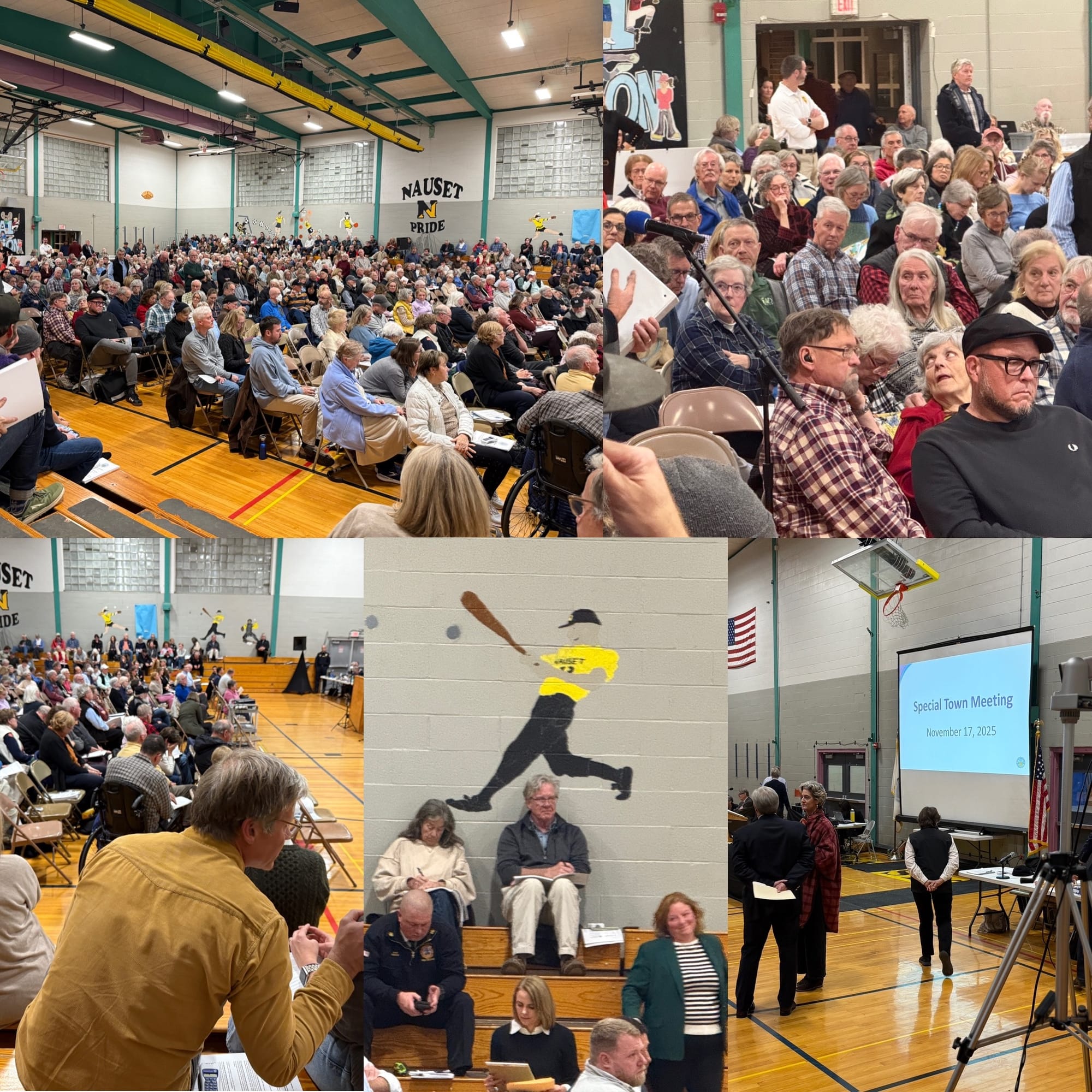
Outside the doors to the Middle School gym, a long line of residents waited to check in and get their electronic voting gizmos. The meeting started 16 minutes behind schedule to accommodate the residents who were still arriving to cast their votes.
There were more than 600 residents in attendance. The 3.5-hour meeting — which was complicated and occasionally unwieldy — was the first for our newly-elected Moderator, John Kanaga, who replaced David Lyttle, our Moderator since 2016.
Two very long conversations dominated the night: Article 2 — the Downtown Housing Overlay (which passed) — and Article 3, a proposal to adopt a more energy-efficient building code (which didn’t). Other notable discussions were over Article 4 — accepting a local option for a new property tax exemption for landlords renting to year-round residents at affordable rates (which ultimately passed) and Article 9, approving the funding of a major upgrade to Eldredge Park (which passed too).
As usual, numbers waned as the night progressed. Twice, motions were made to hear articles out of order, perhaps for fear of losing a quorum (a minimum of 200 residents). Things never got that dire. Nearly 400 voters remained by the meeting’s end.
To watch a recording of the whole meeting, soup to nuts, click here.
What’s the headline? Orleans could look VERY different in a few years…
Read on.
Our Quick Recap:
Downtown Overlay — Article 2: Voters approved a new, optional zoning code for the sewered area of downtown that will likely bring big changes. The new code, which would apply to a specific area of downtown — called an “overlay” — was introduced by Planning Board Chair John Osman as “a new optional approach to the way housing is permitted in the downtown.” Assistant Town Planner Elizabeth Jenkins followed with a slide presentation. The overlay’s purpose is to encourage private developers to build mixed-use buildings and multi-family housing downtown — expanding both the retail environment and the number of modestly priced housing units in town without further burdening taxpayers.
For 55 minutes, a total of 22 speakers expressed sentiments including enthusiasm, skepticism, and fear about the potential change. (The entire new bylaw, including illustrations, can be found on pages 5-33 of the Warrant.) Some were concerned about how new housing and building regulations might change the character of Orleans. (One concern: Is 3.5 stories too high for Main Street?) Several architects worried about the new design standards spoke up. One critic of the new bylaw complained there were too many requirements. Architect and resident Peter Haig said that the new bylaw lacked creativity. “We need to be more aspirational and less legislative.”
Another refrain among skeptics was concern over “who exactly” would occupy the new housing. Others wondered if there was enough parking. One self-described new arrival said, “I like Orleans the way it is.”
Many speakers in support of the change were younger working people and housing advocates. One resident said, “Every person who lives and works here contributes to our town, and everyone deserves a safe and stable home. This isn't about a ‘them.’ This is about all of us.” Alissa Magnotta, CEO of Housing Assistance on Cape Cod (HAC), spoke passionately in favor of the Overlay, saying the housing is for “my kids, my friends’ kids, and all the people we spend our tax dollars to send to school” but who can’t afford to live here. She warned that Orleans is headed in the direction of Nantucket, which she called “a playground for the rich.” If we don’t want that, she said, we need to vote “Yes.”
Nearly an hour in — and while a number of citizens were still queued up to speak — the question was called. The article passed, 345-246
Specialized Energy Code — Article 3: This clocked in as the longest discussion — 57 minutes — as residents debated the pros and cons of adopting the Commonwealth’s new opt-in building energy code, which failed at Town Meeting two years ago.
Thirty speakers took to the floor. For many, the fact that the new energy code would increase building costs undermined the town’s mission to build more attainable housing — as demonstrated by the easy passage of the new Downtown Overlay. Why adopt a new code that could make creating more housing harder? (“The logic of this escapes me,” one resident said.)
For others, the code was just too complicated — and potentially bad for business, according to some builders. Orleans resident Aaron Polhemus, President and CEO of Polhemus Savery DaSilva — a Harwich-based company that builds “exceptional high-end, custom residential homes and select civic and resort buildings,” according to their website — campaigned for weeks against it. Pamphlets that he and other custom builders distributed in the Middle School parking lot before the meeting pointed to vanishing incentives for electrification and the proposed code’s impact on housing affordability. On the floor, Polhemus said, “the reality is it will make projects that the town is trying to create not possible.”
The Cape’s “fragile” and “unreliable” electrical grid was a concern for some. The new code essentially mandates that all new construction be electric or electric-ready, along with other requirements designed to increase energy efficiency. Could the grid support the increase in demand? Yes, according to a spokesman for the Energy & Climate Action Committee, which met with a representative from the Massachusetts Department of Energy Resources the week before Special Town Meeting.
Supporting the article, Energy and Climate Committee Chair John Londa pointed out that in 2020, Orleans voters declared a climate crisis and directed the Select Board to develop a Comprehensive Climate Action Plan (still in progress). Londa said that adopting the Specialized Code — and thus becoming a Climate Leader — would help by giving Orleans access to State grants (up to $1 million every 3 years) to support de-carbonizing municipal operations, potentially including the new Fire-Rescue building. Achieving Climate Leader status was also a FY26 Select Board Goal.
Other residents supported abandoning fossil fuels, and described how solar panels on their homes had resulted in great savings. (“I haven’t paid for electricity in 14 months,” said one.) Select Board Chair Kevin Galligan (speaking as a resident) described the efficiency of the all-electric new affordable housing at 107 Main Street and urged residents to ask for a tour of the units. Select Board Member Michael Herman (also speaking as a resident) asked voters not to keep kicking this can down the road. “We owe this to the next generation,” he said. “This is what you’ve been asking for as a community.”
Midway through the discussion, 15 people were waiting to speak. After nearly an hour, the question was called. The article failed: 245-304.
Affordable Year-round Rental Tax Exemption — Article 4. Would residents authorize the Select Board to design a tax exemption for landlords renting properties at affordable rates to year-round tenants?
Seventeen speakers weighed in. Many of the arguments against the article weren’t about the exemption per se, but about the unknowns of the process as described in the article. With no actual numbers, many speakers seemed skeptical that the exemption wouldn’t increase their taxes. Where were the numbers? Nick Athanassiou, Vice Chair of the Finance Committee explained that his committee would crunch the numbers and advise the Select Board only after a decision is made to create an exemption.
Others trusted the numbers would work out — and saw the exemption as a way to “take the sting off” renting a property year-round — possibly preventing its sale or conversion to a much more lucrative short-term rental. Resident Josh Stewart and others described wanting to continue renting year-round to locals rather than going the short-term route, and said this measure would help. Ultimately, those in favor won the day after 27 minutes and 19 seconds. The article passed, 382-107.
Reimagining Eldredge Park – Article 9: Many young families came to the meeting specifically to support this article. (To accommodate early bedtimes, residents voted to allow the article to jump its place in line and be heard after Article 4.) The question: Would residents approve a $3 million bond for the Community Preservation Committee (CPC) to fund the park’s improvements, which include new pickleball and tennis courts, a trike track, a new playground, a basketball court, accessible pathways, benches, hydration stations, and lighting all around.
YES! was the overwhelming reply. Tracy Murphy, past Chair of the Recreation Advisory Committee, said she’d been fighting for a lighted basketball court for many years, and couldn’t wait to “get this across the finish line.” Orleans Parent Teacher Committee board member Kristin LaPlante spoke about how Orleans kids and families deserve safe, modern places to gather and play year-round. Responding to one complaint about a town with so few children building a better playground, resident Josh Stewart made the point that recreation wasn’t just for kids — it was something for the whole community, including our many “fit seniors.”
Of the 13 speakers, only two were critical of the plan. One complained about “a lot of waste in this project.” The majority disagreed. After nearly 29 minutes, the spirit of excitement and optimism prevailed. The Article passed, 423-39
Land Acquisition for Fire-Rescue — Article 8: This was a quickie. In eight minutes and with no opposition, residents overwhelmingly approved the $1.35 million purchase of 56 Eldredge Park Way for the new Fire-Rescue Station. The money will come from the General Stabilization Fund and therefore not impact taxes. The vote tally: 380-8
Professionally-managed STR Community Impact Fee — Article 5: In just under five minutes, residents voted to institute a 3 percent community impact fee on professionally-managed short-term rentals (STRs). These are rental units managed by an operator with two or more rentals in town and does not apply to the rental of all or part of an owner’s primary residence.) The vote tally was 215-113.
A Special Purpose Stabilization Fund — Article 6: Legally required by the Commonwealth for communities that adopt Community Impact fees, this one passed in one minute by voice vote. The Select Board has decided 75 percent of the fees collected would go toward affordable housing, and 25 percent toward infrastructure projects.
Wastewater Management Engineering Support — Article 10: A routine yearly allotment from the wastewater stabilization funds for planning and support of wastewater management, it passed in 36 seconds by voice vote.
FY26 Budget Adjustments — Article 11: Basic fiscal housekeeping, allocating $95,000 for contract negotiations. Passed in 11 seconds by voice vote.
Yearning for More?
- Watch the whole meeting — we suggest at 1.5 speed!
- Take a look at Town Hall’s Town Meeting page
- Read the Warrant
- EXIT 89’s Preview of Special Town Meeting has detailed explanations of articles
- Here's The Cape Cod Chronicle’s Special Town Meeting wrap-up
- Kim Newman's note to residents in last week’s Town Talk
- At the November 19 Select Board meeting, there was a review of Monday night’s proceedings with thoughts about how to improve future meetings

EXIT 89 is an independent publication. Our mission is to help Orleans voters make sense of town issues by providing a clear and impartial overview of the latest developments. We want to help fill the information gap, reduce the "mystery" of Town Meeting, and promote vibrant civic engagement.
Our hyperlocal digest is researched and written by journalists Martha Sherrill and Emily Miller. Elaine Baird and Lynn Bruneau are the founding advisors. We are all residents of Orleans. Editing, infographics and tech support are provided by Kazmira Nedeau of Sea Howl Bookshop. Additional research and writing for this issue was provided by Orleans resident Steve Gass. Thanks, Steve!
Our digest is 100 percent free — and we aim to keep it that way. But your donations keep us going. You can donate securely online by clicking here. Or you can send a check to "EXIT 89" and save us a processing fee. Our address is: EXIT 89, P.O. Box 1145, Orleans, MA 02653.
As always, we’d love to hear from you. Please share questions, comments, and ideas for future issues at hello@exit89.org. If you are new to EXIT 89, please take a moment to sign up for a free subscription. And if you’ve been here a while and enjoy it, please forward to a friend.
As always, thank you for your support!