Special Town Meeting Postmortem — November 16, 2026
Issue No. 37 — Our postmortem of Special Town Meeting where two emergency back-up generators were approved, along with two zoning bylaw changes. A Citizen Petition provoking the State to focus on the water quality of Nauset Estuary took the most time and attention, but failed.
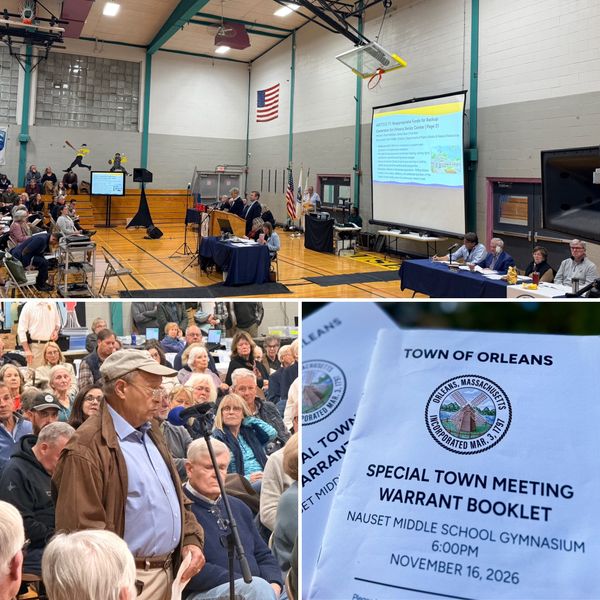
Monday's meeting; Bill Amaru, bottom left, co-author of a Nauset Estuary Citizens Petition
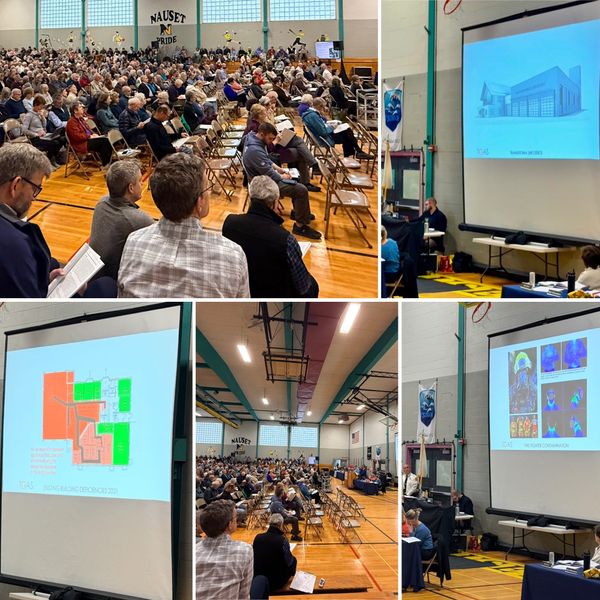
It was a night of rapidly proceeding votes. About 475 Orleans voters turned out, speeding through 22 articles in just under two hours. Only a few articles took longer than three minutes, start to finish. There was a 10 minute and 48 second discussion about Article 7, which proposed some minor amendments to our new downtown overlay district bylaw. (To hear why Article 7 failed, keep reading.) Article 20, which asked for funds to replace a 22-year-old emergency generator at the Water Treatment Plant, provoked 11 speakers to dig into the weeds of the generator motor failure, question the need for a replacement, and then question the wording of the article.
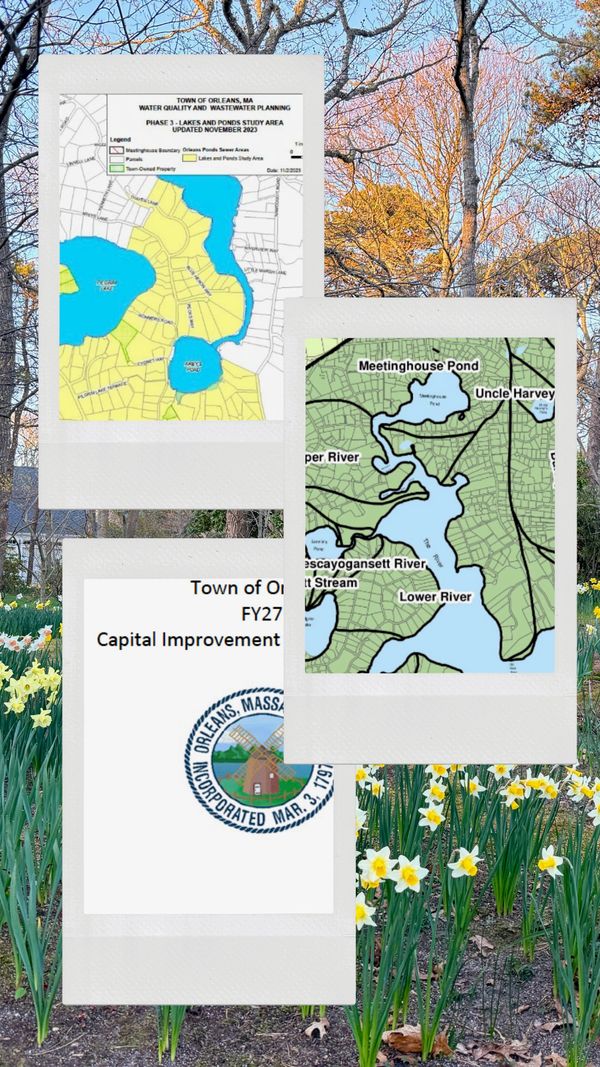
But the main event of the night was Article 22, a Citizen Petition seeking to address the ongoing problem of nitrogen pollution in Nauset Estuary. Twenty-six residents spoke, all agreeing that the estuary — which includes Town Cove, Nauset Harbor, Wood Cove, Roberts Cove, and Mill Pond — is in jeopardy. What they didn’t agree on was what to do, or when to do it.
Here’s EXIT 89’s take on how the evening went down:
Zoning Bylaw Changes
Articles 5+6, both proposing changes to our zoning bylaw, were introduced by Planning Board Chair Debbie Oakes and explained by Assistant Director of Planning and Community Development Elizabeth Jenkins. They passed quickly and pretty handily. (Article 5 — updating the Use Table and Use Regulations — passed 287-138, and Article 6 — pertaining to parking and loading — passed 312-133). Article 8, which proposed legal, technical and administrative updates, also passed easily in2 minutes, 31 seconds (343-130).
Article 7 was a different story. Despite the changes in the article being described as “minor” by Elizabeth Jenkins, residents expressed major concerns: overdevelopment, overpopulation, and overuse of our natural resources foremost among them. The changes cited in the article, which included removing a ceiling-height minimum for certain buildings and allowing developers building attainable, year-round housing to be exempted from the requirement to make a certain percentage “Affordable” — deeded for households earning 80 percent or less of Area Median Income (AMI) — seemed to stoke fear among residents, whose comments reflected the sentiment that building and development in Orleans has gone too far. One resident asked what the Town’s “target population” was. Jenkins responded that the article’s aim was not to expand the population, but to provide opportunities for people who have grown up here, or are growing up here now, or are employed here, to live here. Another resident asked whether the aquifer could support more development; the answer was “Yes.” Yet another speaker cited Hyannis and “the devastation of such crazy buildings going up,” and said development in Orleans should be “curtailed.” After 10 minutes and 48 seconds, the article failed to meet the required two-thirds majority, but came close (281-180.)
Emergency Backup Generators
Article 17 asked for funding for a new backup generator for the Council on Aging. Only one question from the floor: Who would be maintaining the new generator, and bearing the costs? The answer, from DPW Director Rich Waldo: ongoing operating and maintenance costs would be included in the annual DPW budget. It passed by the necessary three-quarters voice vote.
Article 20 asking for “the sum of $722,950, or any other sum” in order to replace the old and failing emergency generator that serves the Water Treatment Plant and Wells 4 and 5 provoked questions about the need for replacement and how many times the generator had been used over its 22-year life. But most of the 13 minutes and 40 seconds were spent on the strange wording (“or any other sum”) used in this article and similar funding articles. As explained by Town Manager Kim Newman, the phrase “any other sum” refers only to the possibility of a lower amount. A higher sum or cost would require another vote at Town Meeting. Still, one resident wanted it stricken from the article language. With the help of Town Counsel, the change was made and the article passed, 455-25.
Nauset Estuary
Article 22, a motion that replaced the original Article 22, a Citizen Petition, was introduced by Charles Carlson, one of the three original petitioners. The updated motion, which was printed and distributed at the meeting, asked that $200,000 be transferred and allocated from Free Cash to pay for part of the State, EPA, and Town costs for establishing Total Maximum Daily Loads (TMDLs) for the Nauset Estuary, with the ultimate goal of spurring the Town into more aggressive action in cleaning up the Nauset Estuary. This includes Mill Pond, which is widely understood to be in dire ecological straits.
To begin the discussion, Town Moderator John Kanaga asked the Finance Committee to explain their split vote. Tony Pearl, a Finance Committee member, kicked off the debate, speaking in favor of the motion. “Orleans needs to pass Article 22 now,” he said, arguing that only with official TMDLs can Orleans understand what needs to be done, and at what cost. His support for the article was in the minority among Finance Committee members. (Their vote was 2-4-2.)
Finance Committee Vice Chair Elaine Baird (also an EXIT 89 advisor), representing the Committee’s majority view, called Nauset Estuary “one of the great treasures of Orleans,” but reminded voters that Orleans has agreed to a State-approved plan to make Pleasant Bay watershed a priority before taking on Nauset Estuary, and has committed itself to its wastewater management plan. She worried about “doubling up” the amount of money residents would need to spend if phases of the sewer plan were to be altered.
Judith Bruce, an Orleans Pond Coalition (OPC) board member and member of the Orleans Wastewater Management Advisory Committee, said “my heart embraces the goal of this petition,” but she worried about the costs that could result from amending the wastewater plan to address Nauset Estuary sooner than planned, and said she did not support the article.
Select Board member Kevin Galligan (also Chair of the Wastewater Management Advisory Committee and Orleans representative to the Cape Cod & Islands Water Protection Fund Management Board), explaining the Select Board’s unanimous “No” vote on the article, argued that Eastham and Orleans are already doing a lot to improve the Estuary. Eastham has developed a s $170 million sewering plan, and Orleans’ “adaptive management plan” which he noted includes Permeable Reactive Barriers at the Nauset Regional Middle School, aquaculture, and our wastewater management system. ”We have a plan, it’s working, let’s stick with it,” he said. Others speaking against the article expressed similar sentiments — that Orleans must clean up Nauset Estuary, but that this article was not the way to go about it.
Proponents of the article argued that the petition was a necessary step toward understanding the conditions of the estuary and doing more about it. Resident Doug Systrom, who volunteers as a water tester in parts of the estuary, spoke to the “dead” state of Mill Pond. Co-petitioner Bill Brotherton pointed to the economic value of the estuary and said, “We cannot afford to keep putting this problem off.” Bill Amaru, the third petitioner, said, “We cannot and should not wait to return Nauset Estuary to a healthy and productive state.” Sewering is part of the solution, but only part, he said, and added, “We are the ones responsible for what’s happened to the estuary, and we will be the ones to decide if it gets fixed,” closing his remarks with, “Thank you, Orleans citizens, I love you all.” After one hour and 26 speakers, resident Alisa Magnotta called the question: that vote passed, 421-23. Article 22 failed, 174-282.
Want More?
To read more about the debate over Nauset Estuary’s future and the rest of the Special Town Meeting:
For an official debrief of proceedings, the Orleans Select Board has scheduled its postmortem of the meeting for Wednesday, December 2, 5:00 PM, at Town Hall's Nauset Room. You can attend in person, remotely on zoom, or watch a recording afterwards.
EXIT 89 is an independent publication. Our mission is to help Orleans voters make sense of town issues by providing a clear and impartial overview of the latest developments. We want to help fill the information gap, reduce the "mystery" of Town Meeting, and promote vibrant civic engagement.
Our hyperlocal digest is researched and written by journalistsMartha Sherrill and Emily Miller. Elaine Baird and Lynn Bruneau are its founding advisors. Editing, infographics, and tech support are provided by Kazmira Nedeau ofSea Howl Bookshop. In the fall of 2025, Steve Gass joined our team to help with additional research and editing.
Our digest is 100 percent free — and we aim to keep it that way. But your donations keep us going. We appreciate every single one of them. Donate securely online by clicking here. Or you can send a check to "EXIT 89" and save us a processing fee. Our address is: EXIT 89, P.O. Box 1145, Orleans, MA 02653.
If you are new to our newsletter, please take a moment tosign up for a free subscription. And if you’ve been here a while and enjoy it, please forward to a friend.
As always, we’d love to hear from you. Please share questions, comments, and ideas for future issues at hello@exit89.org.