Preview of Town Meeting — May 11, 2026
Issue No. 34 — Big decisions to make at Annual Town Meeting, including the FY 27 Operating Budget and the biggest ticket item of the Warrant, a new Fire-Rescue Station,
– 22 min read
Issue No. 34 — Big decisions to make at Annual Town Meeting, including the FY 27 Operating Budget and the biggest ticket item of the Warrant, a new Fire-Rescue Station,

Spring has sprung — finally.
This year it feels more well-deserved than ever.
Along with the seasonal shift to sunshine and daffodils, we have much to be grateful for. Our little town — especially the DPW, First Responders, and Town Staff — rose to the challenges presented by the Blizzard of ‘26. The damage was extensive. Trees, limbs and power lines were down everywhere. Schools and Town Hall offices were closed all week, and 97 percent of homes and businesses in Orleans lost electricity, many for several days. Despite the brutal conditions, our Town employees and Eversource had us plowed, powered, and back in action remarkably quickly.
And now, thankfully, it’s May. Time to turn our attention to Annual Town Meeting, less than a week away.
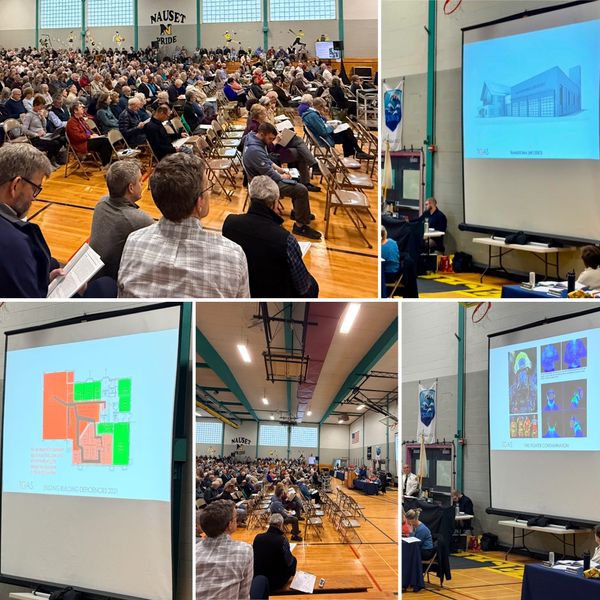
Maybe you haven’t missed a Town Meeting since the first time we made it to the moon. Or maybe you’ve never been. Either way, here are the details:
When: Monday, May 11, 6 PM
Where: Nauset Regional Middle School Gym
Doors open and registration begins at 5 PM. Arriving early is never a bad idea. (Town staff will be available starting at 4 PM to answer Warrant questions.) Even if there’s a long line of people waiting, the meeting will be called to order at 6 PM sharp.
Check in, grab your handheld electronic voting gizmo, then find a seat and get comfy. Bring some water, maybe a snack, and your copy of the Warrant. (Printed copies are available at Town Hall.) You can watch the live-stream on Channel 1072 or see a recording later, but all votes must be cast in person.
Families: The Orleans Recreation Department will offer free childcare and pizza in the Nauset Regional Middle School cafeteria from 6-9 PM for children ages 4 to 13. (Rec staff will be on-site and ready to welcome children starting at 5:30 PM.) Parents MUST PRE-REGISTER their children online or call 508-240-3700 (ext. 2333) by this Friday, May 8.
We hope you’ll attend!
This year, we have 36 articles to vote on — many of the garden variety, plus a few stand-outs. Keep reading to see what caught EXIT 89’s eye. . .

A Consent Calendar is a group of articles that the Select Board has deemed non-controversial — or needing no discussion — to be voted on in one fell swoop. Many of the offerings are in this section of the Warrant year in and year out, and traditionally pass unanimously, such as Town retiree health benefits (OPEB Liability Trust Fund) and various stabilization funds (municipal “rainy-day” savings accounts).
If you’d like to remove an article from the Consent Calendar and have it voted on separately, contact Town Hall in advance or show up early to the Nauset Middle School gym, where you can submit a written request with the signatures of five voters before Town Meeting starts. You can also provide an oral request from five voters before the Consent Calendar is voted on.

The Orleans Town Charter calls for the development and periodic updating of the Orleans Comprehensive Plan; it's a “living document” that is amended over time. The plan does not spend any money or adopt any regulations. It is simply meant as a roadmap, or “viable reference and guidance document for the appropriate and orderly development of the Town.”
The new, updated plan — “ORLEANS 2050” — offers more than 248 pages of text, illustrations, and helpful infographics. It was developed by the Orleans Planning Board, the Planning and Community Department staff, and the consulting firm Tighe & Bond, with substantial input from the Town’s Boards and Committees. It’s the product of three years of work that included a community survey, data analysis, visioning workshops, staff input, and numerous public input sessions.
According to the introduction: “This roadmap is for everyone: Residents can — and should — use it to track progress and hold Town leaders accountable.” Topics covered include sustainable population growth, climate change, protecting our waters and other natural resources, preserving open space, economic development, housing, community services, historic preservation and cultural heritage, town governance, and infrastructure and roadway improvements.
Want more info? Listen to the Orleans: Behind the Scenes podcast’s episode on the Comprehensive Plan.
Both the Select Board and Finance Committee voted unanimously in support of Article 15, which requires a simple majority vote to pass.
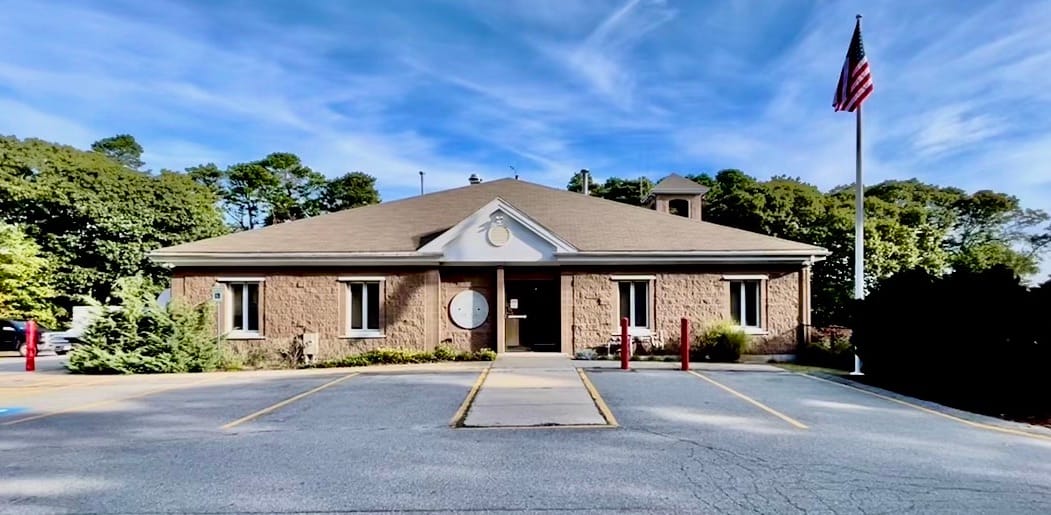
Throughout the years-long, on-again, off-again saga of the Fire-Rescue Station, one objective has been a constant: locating the new station on Eldredge Park Way, where the current station sits, or close to it, would be ideal. (Check out the 2022 Fire Station Location Alternatives Study to dig into why.)
The Town’s 2025 acquisition of the 0.82-acre parcel at 56 Eldredge Park Way went a long way toward achieving this goal. But it wasn’t perfect. That lot, which abuts the current Orleans Fire-Rescue Station, is small in relation to the planned facility, and access to it — for both construction vehicles in the near future and emergency vehicles later on — would have been tricky, especially given its close proximity to Orleans Elementary School (OES).
Article 16 proposes that the Town purchase a 0.48-acre section of the 1.48-acre property — at 48 Eldredge Park Way, home of Lower Cape Dental Associates. The purchase will allow for safer and more efficient vehicle access during construction, and better traffic and pedestrian flow at the future station. It would also keep construction traffic and future emergency vehicle traffic well away from OES.
Lower Cape Dental Associates will continue to operate, uninterrupted. Article 16 asks voters to approve transferring $600,000 from free cash to make the purchase. The Select Board and Finance Committee both voted unanimously in support of this article. A two-thirds majority vote at Town Meeting is required for it to pass.
That brings us to one of the most anticipated discussions of the night: Article 17, asking voters to authorize borrowing up to $60 million for the construction of the new Fire-Rescue Station.
Yep, up to $60 million. The final figure could actually be smaller (though likely not a lot smaller). The Select Board will be deciding on the exact funding request at their May 6 meeting.
Before sticker-shock causes you to jump out of your chair and rage-delete this entire preview, let’s see if EXIT 89 can answer some basic questions for you.
Do we really need a new station?
It is widely accepted that, yes, we are in dire need of a new station — and that it’s long overdue. At the April 15 Select Board Meeting, Orleans Fire Chief Geof Deering spelled out how the current station is “outdated with major deficiencies,” including insufficient space and a layout that slows response times, as well as serious health and safety concerns for the staff. Specifically, he cited, “air quality, mold, rodents, roof leaks, recurring plumbing and electrical problems, and ongoing lack of space for training and equipment.” (Here’s more on why the current station must be replaced.)
Wait…what happened to the $45 million price tag we heard about two years ago?
That figure was a rough cost-per-square-foot price for a roughly 40,000 square foot station — the product of multiple feasibility studies and site analyses. (Note the repeated use of the word “rough.”) The specific number — $44.7 million — can be found in the April 2025 Orleans 2040 Campus Feasibility Study, conducted by The Galante Architecture Studio. The study included an extensive analysis of the Fire-Rescue Department’s current and future programmatic needs. At that time, no building site had been secured. As Ted Galante, the project’s lead architect, told the Select Board on April 15, “costs only go up.”
For a deeper understanding of the whole picture, take a look at the slides from Galante’s presentation to the Select Board on April 15, 2026. You’ll find site plans, detailed programming needs, a tentative construction schedule and budget, and more.
If that all sounds TLDR (too long, didn’t read, as young people say), here’s the bottom line: Construction costs for the new station are now estimated to fall between $44.3 and $48.6 million. Additionally, there are “Owner’s development costs,” also known as “soft” costs, which include Owner’s Project Manager (OPM) and Architect and Engineering fees (some of which are covered by the $4.5 million voters approved at the May 2025 Town Meeting), plus additional required surveys, testing, consultants, audio-visual systems, communication systems, IT systems, and commissioning (ensuring everything’s working right, before close-out) and more — adding between $8.3 and $11 million, and bringing us to a total estimated cost of $53-$58 million. Important: This number, which was generated by TGAS and Pomroy Associates, the Town’s OPM, is in December 2028 dollars — the midpoint of the project — assuming a cost escalation of 4.5% per year.
A few more considerations:
1. This will be no ordinary building: Risk Category IV buildings — air traffic control centers, hospitals, police stations, power generating stations, and fire stations, among others — are designed to be the “last buildings standing” after catastrophic events like hurricanes, tornadoes, and earthquakes. Weather events have grown more extreme in the decades since our current station was built — and emergency technology has changed, too. Public safety buildings require extremely sophisticated technology and communication systems which also have to function through those catastrophic events. They also have highly specific space and materials requirements to ensure the health and safety of the first responders. None of these things come cheap.
2. Site complexity: First, the building parcels are not level — this means lots of excavating and filling, which is expensive. The existence of the current facility, built in 1987, further complicates things, since it’s directly behind the new site and must remain fully operational and accessible to the public until the new facility comes online. Second, the new site is hemmed in by Nauset Regional School District property to the east, and Lower Cape Dental Associates to the west — leaving not much “wiggle room” for a large and complex undertaking — which means carefully planned phasing and associated costs.
3. Size: The new building will be large — around 40,000 square feet, according to recent building plans. While this may seem disproportionate to the 6,000 or so people who live in Orleans year-round, our infrastructure, including public safety, has to serve our much larger summer population, estimated to be 20,000 or more. The station, currently in the schematic design phase, will include living quarters for 12 firefighters, designated decontamination zones to ensure firefighter health and safety, five major apparatus bays fronting Eldredge Park Way, several minor bays in the rear, and a four-story training tower. It will also include rooftop and parking-canopy solar arrays and a storage facility out back — with the intention of meeting the department’s needs now and for the next 50 years.
Another factor: The Select Board’s charge for the new station includes a provision that it be “net zero,” meaning it produces enough renewable energy on-site to offset all the energy it consumes on site. Technologies employed will likely include solar panels and batteries, triple-glazing windows for efficiency, and all-electric operations (appliances, boilers, furnaces, etc. — not counting back-up generators). While these will add upfront costs (current estimate is about $800,000) they are designed to save money in energy costs once they are online. The upfront costs are included in the current estimates.
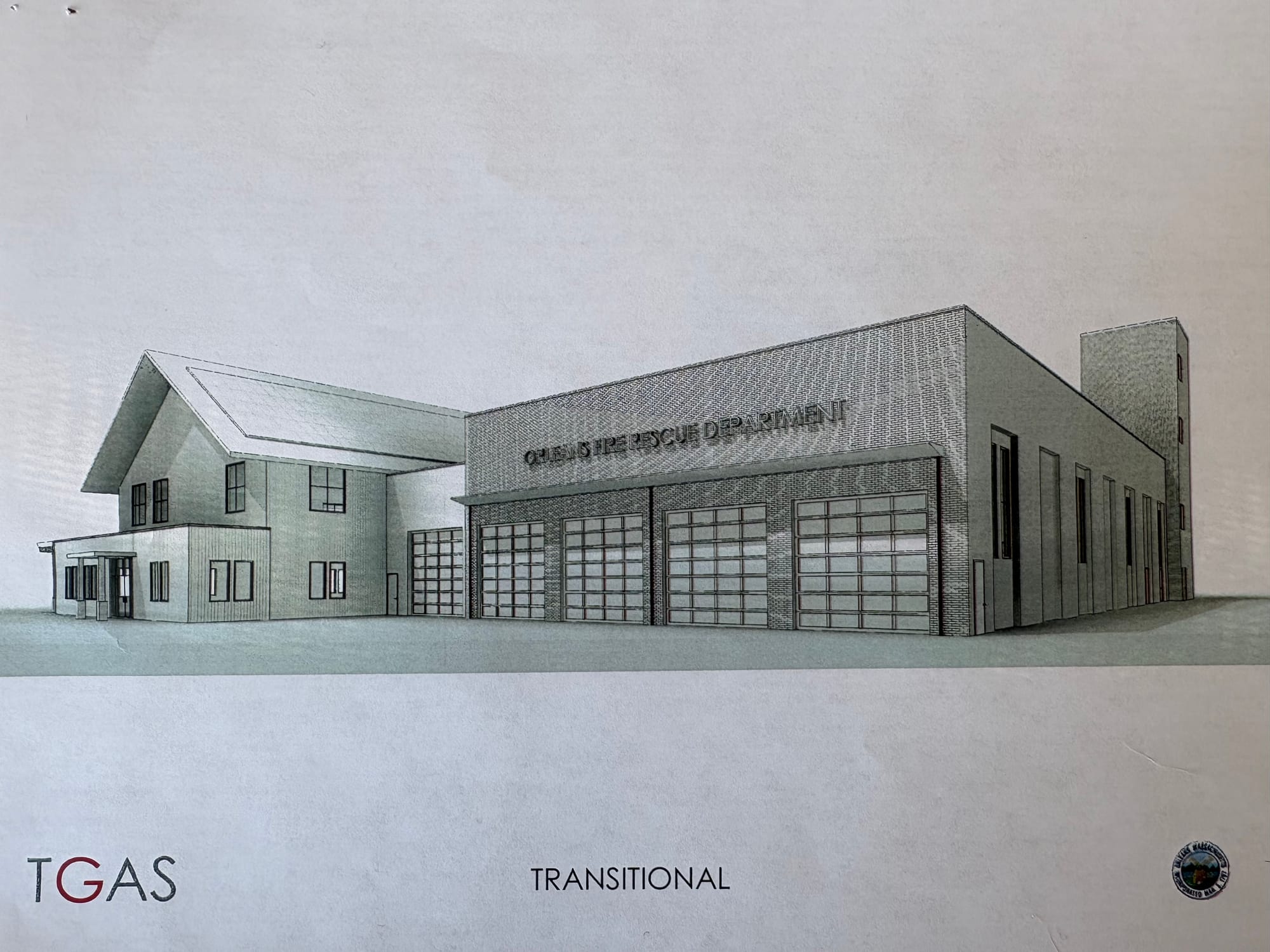
Do we know what the new station will look like?
Not exactly. The Fire-Rescue Station Building Committee voted at their May 4 meeting to recommend a design direction (see illustration above) to the Select Board, which will accept or reject the recommendation at their May 6 meeting. Key point: the image above is a preliminary rendering of the building’s general shape and style — not an actual design. The design phase still has a ways to go. An official schematic design (the first phase in the design process) should be ready in a few weeks — pending instructions from the Select Board and Town Meeting approval. That will be followed by a more detailed cost estimate, and ultimately a final design, which will also need approval from the Select Board. Once approved, construction drawings will be created and the project will be put out for bid.
Do we need a design to approve funding, legally?
We don’t — and Town officials and staff have decided that securing funding for the new station is the top priority.
When would the new station be ready?
Preliminary timelines provided by TGAS to the Fire-Rescue Building Committee and the Select Board have construction starting sometime around June 2027 and taking 14-16 months.
How would this project impact our property taxes?
Bonds for large capital projects aren’t issued until after they are completed. Financing for the new Fire-Rescue Station would likely begin in FY 31. Darrin Tangeman, Orleans Finance Director, told the Select Board on April 15 (his presentation starts around 52:20) that assuming a 4.5 percent interest rate, a $60 million, 30-year loan would add $581.49 to the Fiscal Year 2031 tax bill of a $1.36 million property (the projected median home value in Orleans in 2031). A $50 million loan would add $484.57 to the same property’s 2031 bill.
The Select Board and Finance Committee will present their votes on Article 17 by the start of Town Meeting. A two-thirds majority vote at Town Meeting is required for the article to pass, followed by the approval of a Proposition 2-½ override at the Town Election on May 19.
Got more questions? Watch or attend the Select Board’s May 6 meeting at 5pm in the Nauset Room at Town Hall or via Zoom. Also, check out a video presentation offered by the Town, and the Orleans Fire-Rescue Station Headquarters page on the town website. You can also contact Chief Geof Deering directly at gdeering@orleansfd.com or by phone at (508) 240-0050 with questions.
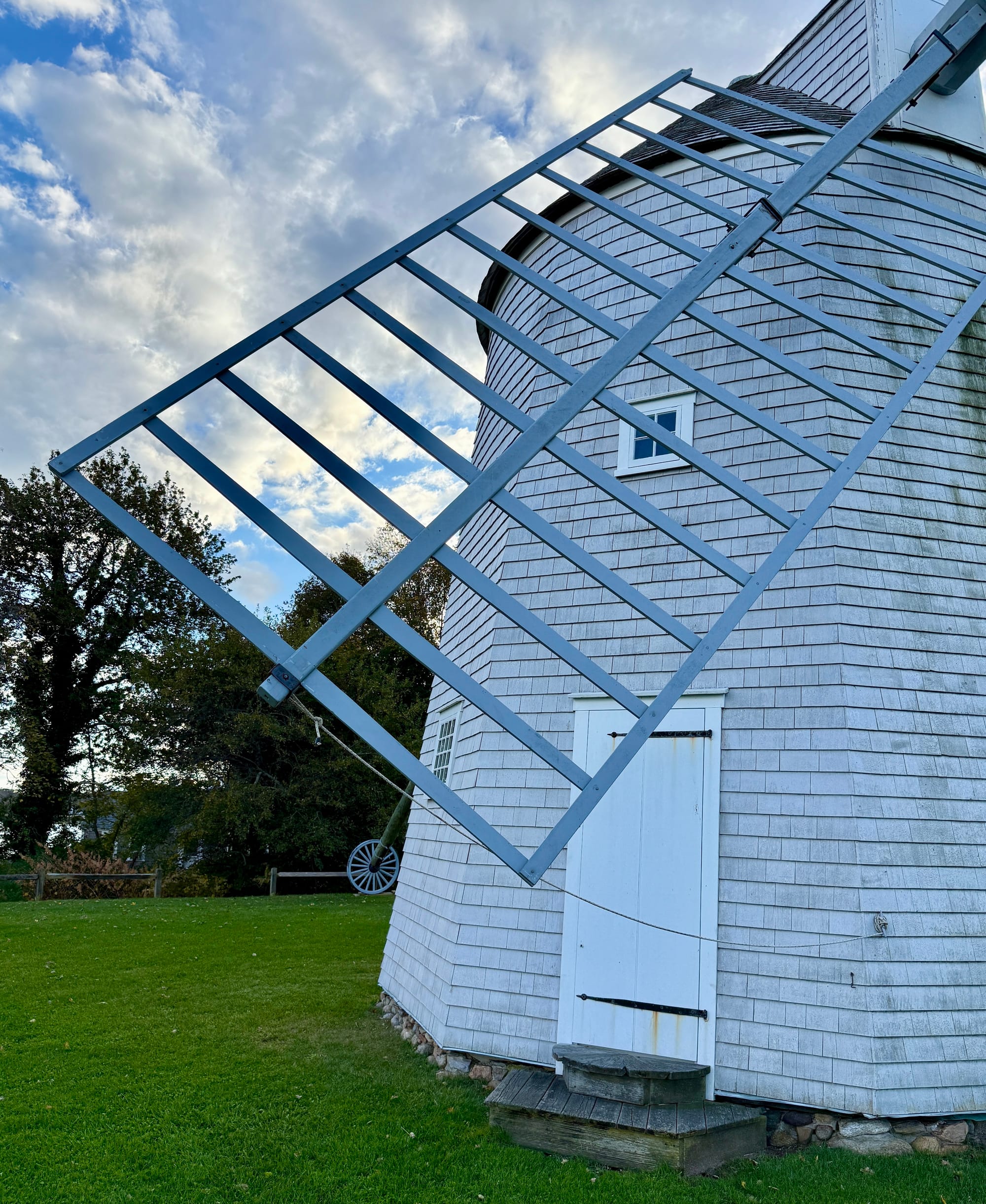
It’s usually the biggest ticket item on the Warrant, but this spring the Operating Budget — this year’s coming in at $56,598,164 — plays second fiddle to Article 17 for the New Fire-Rescue Station.
What you mostly see in the FY 27 budget are the municipal services that residents enjoy day in and day out in Orleans. Increases are evident throughout as the cost of living continues to rise in Massachusetts, and nationwide.
The overall budget is up 5.57 percent. Select Board/Town Manager expenses up 14 percent — largely due to an additional $150,000 for Select Board Programs/Initiatives and $61,000 in salary-related expenses. Finance/Accounting Department costs are up 37 percent, due largely to an additional staff member. Public Safety costs rose 6 percent — mostly union-contract-driven — and Community Services are up 10 percent, which includes a new Council on Aging Assistant Director position to be funded through an override, and a Rental Inspector, funded by the fees collected through the rental inspection process.
Debt service rose by $1.07 million — up 17 percent.
Why?
(Disclaimer: this gets a little weedy, but we think it’s worth the pain. Financial planning is rapidly taking center stage in our town. The more we understand, the better.)
In early January, the Town worked with its financial advisors on the sale of a number of Bond Anticipation Notes (BAN’s — or temporary borrowing) and bonds (permanent borrowing) to finance projects previously approved at Town Meeting. Keep in mind, bonds aren’t issued until the projects being financed are completed, but BANs are issued for projects-in-process.
This year’s BAN projects included a new aerial ladder truck for the Fire-Rescue Station, the Rock Harbor Wharf project, the Town Cove Bulkhead, and design for Phase 3 of Wastewater. Bond financing projects include 107 Main Street affordable housing, IT system upgrades, Rock Harbor dredging, and some Wastewater Phase 2 costs. (Not all of the latter were eligible for State zero percent interest financing.)
For a full-body immersion in bonds and BANs, see Treasurer Scott Walker’s memo to the Select Board outlining all of the projects requiring a bond issuance or BAN on pages 11-14 of the January 14 Select Board Meeting Packet. At the meeting, the Select Board voted unanimously to accept and confirm the borrowings. For another look at the FY 27 operating budget, listen to the April 2, 2026 episode of the Orleans: Behind the Scenes podcast. For even more detail here’s the whole enchilada — the budget in its entirety, including narratives of what each department does and line items for its expenses.
Both the Select Board and Finance Committee unanimously support Article 19, which requires a simple majority vote to pass. One line item — funding the new COA director — will require approval of a Proposition 2-½ override on the Town Election ballot on May 19.
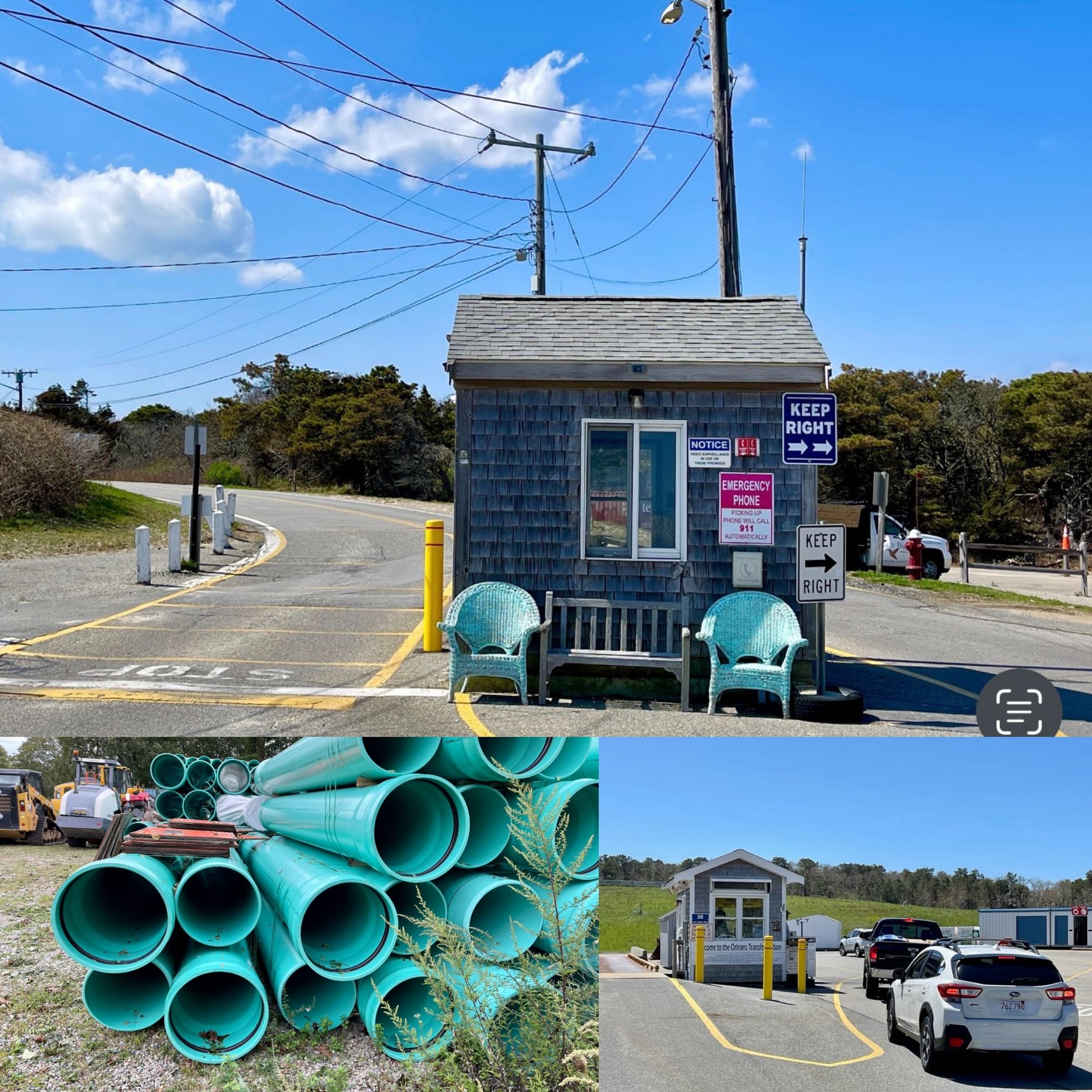
An Enterprise Fund (EF) is an accounting method that shows each service in a profit-and-loss format. There are three EFs in our FY 27 budget — Beaches (Article 20), Sewers (Article 21), and the Transfer Station (Article 22). All of them are managed by the Department of Public Works & Natural Resources (DPW).
The hope is that each fund will eventually become self-supporting through user fees, rather than being subsidized by property tax revenue or other funds. Currently two of them — Beaches and Sewers — are breaking even.
Are fees changing to keep these services self-supporting? The Sewers EF (also supported by the Special Purpose Wastewater Stabilization Fund) includes no change to the fee schedule for FY 27. The Beach EF, though, is getting a boost from rising fees. Daily parking at Nauset and Skaket beaches will rise from $32.50 to $35. Annual fees for Resident Beach Stickers are rising from $25 to $35 — and will now be required for parking at Kent’s Point, in addition to many Town landings.
The Transfer Station EF is not self-sustaining. It relies on fees paid by residents, business owners, and visitors for regular trash disposal and recycling, as well as itemized charges for disposal of specific items — including demolition and construction debris, boats and trailers, tires, lawn mowers, propane tanks, grills, refrigerators, mattresses and microwaves — and still requires a $540,000 tax levy subsidy to operate. (The full fee structure for the Transfer Station can be found on page 58 of the Warrant.)
All three articles are supported unanimously by both the Select Board and Finance Committee. A simple majority vote at Town Meeting is required for each to pass.
The Orleans Town Charter requires that we vote each year on a Capital Improvement Plan (CIP). What’s a CIP? It’s a look ahead at the capital expenses that may be coming down the pike in the next five years (FY 27-FY 31) — with an emphasis on “may.” Unlike the Capital Budget, the CIP does not approve, commit to, or fund any expenditures. It's merely a way of anticipating potential future capital expenses. Article 23 asks voters to adopt the FY 27-FY 31 CIP.
You can see the CIP here or find it on pages 60-71 of the Warrant — with detailed descriptions of each potential project for the next five years on pages 72-93. Both the Select Board and Finance Committee voted unanimously in support of the CIP. A simple majority vote at Town Meeting is required for the article to pass.
Article 24 deals with the Capital Budget — the coming fiscal year’s actual capital expenses. This year, we will be voting on this budget in six different motions, each motion concerning a different set of expenses: Vehicles and Equipment; Buildings and Facilities; a Water Department storage tank rehab; Beach and Transfer Station expenses; a new Fire-Rescue ambulance; and finally, Motion 6, which includes four capital expenses not included in last year’s CIP and thus requiring a three-quarter majority vote to pass. (The other five motions require only a simple majority.)
You can find the Capital Budget in the Capital Improvement Plan, and read the various projects’ details on pages 72-77 of the Warrant. While the Finance Committee continues to advocate strongly and loudly for Orleans to have a long-term Capital Plan, so that infrastructure needs (wastewater, housing, schools, library) are placed on a timeline longer than five years, it voted unanimously in support of Article 24, as did the Select Board.
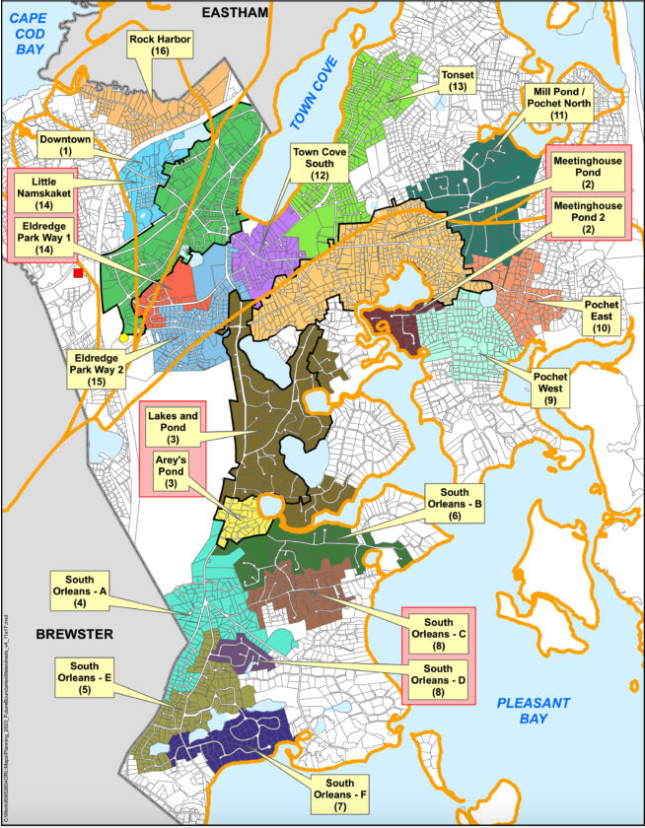
Orleans has made a strong commitment to sewering. It took many years of embattled Town Meetings, public hearings, and information sessions to convince residents that the old-school way of dealing with human waste in our fragile ecosystem — septic fields and cesspools — was destroying our ponds, estuaries, and harbors. (For more background on this, see EXIT 89’s deep dive in 2024, Water, Water, Everywhere.)
Residents and commercial property owners knew the price tag for building a new wastewater treatment facility and collection system, then digging up our streets and connecting homes and businesses to it, would be high. But residents and commercial property owners took it on.
Phase 1, which creates a collection system for the downtown area, and Phase 2, covering Meetinghouse Pond, are complete. (Meetinghouse Pond property owners have received their “letters to connect” and more than 100 have approved plans to do so.) These two phases represent some of the densest and most problematic areas of town, where excess “nutrients” were flowing to Town Cove, Meetinghouse Pond and other water bodies.
Article 25 moves the project along, asking voters to approve $2.7 million for an engineering survey and preliminary design and planning (including public engagement) for Phase 4, as well as ongoing regulatory and environmental work. This phase would sewer a section of South Orleans that impacts Pleasant Bay Estuary. The 5-year CIP estimates an additional $5.3 million in FY 28 for design and engineering of this phase, and $43.3 million in FY 29 for construction.
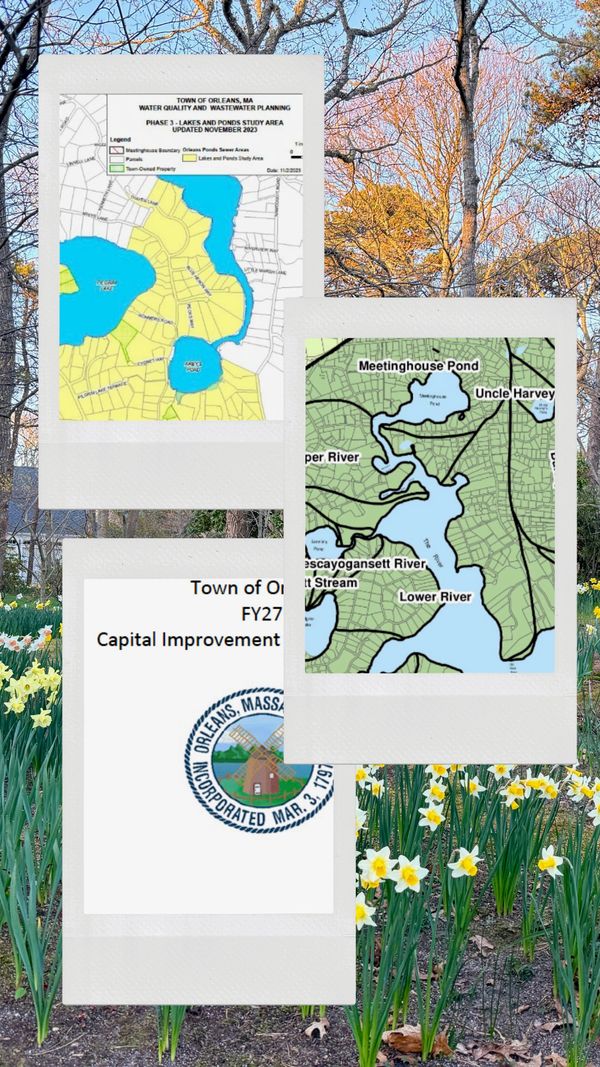
Article 26: Last spring, voters approved $40.5 million in funding for Phase 3, which addresses the Lakes and Ponds Area (see map above for a general idea of the location). The bid opening for this phase was scheduled for the end of last month, but the results were not available by the time we published this preview. (They will be available by Town Meeting.) If the bids come in at or below the $40.5 million, then no extra funds will be needed and this article will be postponed indefinitely. If the bids are higher, these are the funds needed to meet State funding deadlines and keep the project on schedule.
As we’re likely to see at Town Meeting, a divergence of opinions as to how — or if — we should proceed with the wastewater project is becoming evident. The Select Board voted unanimously in support of both articles. The Finance Committee offered unanimous support for Article 26 — the additional funds (if needed) to complete Phase 3. Regarding Article 25, six members voted in favor, two against, and one abstained.
While clearly voicing its belief in the value of clean waters, the Finance Committee expressed concern in its annual letter over the immense expenditure involved — a financial burden that could keep our town from being able to afford a new library, a new school, a new senior center, a community center, and many other major wants and needs for many years to come.
What is wastewater costing us?
The price tag for the first two phases, according to the Finance Committee, was $59.2 million and $32.9 million respectively — totals which do not include the 25 percent clean water subsidy provided by the Cape Cod & Islands Water Protection Fund that comes from Short-term Rental Tax revenue. This is separate from the Town’s Special Purpose Stabilization Fund for Wastewater, which is supported by the Local Option rooms excise tax — 6 percent on top of the regular Short-term Rental tax — as approved by Town Meeting in May 2019.
So… what’s the estimate for all 16 phases?
AECOM’s 2024 estimate, according to George Meservey, Director of Planning and Community Development, is $501 million — in today’s dollars — if the clean water subsidies continue and all 16 phases proceed as originally planned.
The Finance Committee letter advocates that the Town look at all other options and “should affirm an ongoing commitment to examine the cost effectiveness of alternate water treatment methods such as oysters, permeable reactive barriers and urine diverting technology.” It also urges that more be required from property owners regarding fertilizer use. “A policy with strong enforcement teeth should be developed to reward those who do not use nitrogen fertilizers and fine those who choose to do so . . .”
Both articles require a two-thirds vote to pass.

Community Preservation Committees (CPCs) have been established in 201 cities and towns across the Commonwealth, with the objective of “preserving and improving a community’s character and quality of life.” The appropriations for the Orleans CPC are funded primarily by state contributions and a three percent surcharge on our property tax bills.
Each year, the Orleans CPC reviews applications from local organizations and town departments seeking to enhance our open space, recreation, affordable housing, and historic preservation initiatives, then offers recommendations for Orleans voters to approve.
Article 28 asks voters to approve nearly a dozen recommended projects. Along with $1 million towards an Eldredge Park Renovation (approved by voters at last year’s Special Town Meeting), projects include $50,000 to create an archiving system for historical material at the Centers for Culture and History of Orleans (CHO), $120,000 for the restoration of our Civil War monument, $90,000 for Putnam Farm to create additional community agricultural space, and $300,000 to the Affordable Housing Trust Fund. You can find more details on pages 30-31 of the Warrant. For the latest on the Eldredge Park upgrade, you can watch the April 16th meeting of the Recreation Advisory Committee.
Article 29 asks voters to approve using $175,000 of CPC funds for the Town to purchase a conservation restriction at 32 Locust Road. Because this acquisition is in partnership with a local non-profit, the Orleans Conservation Trust (OCT), it needs to be voted on separately.
What’s the story with this purchase?
This is the largest unprotected pond-front parcel left in Orleans, adjacent to twelve acres of OCT and Town-owned open space. The Town will own the conservation restriction, which protects the property for conservation and passive recreation purposes in perpetuity, and the OCT will own and manage the property, which is being sold for a total cost of $585,000. If the purchase is approved, it will prevent residential development there, safeguard critical pond-shore habitat, and protect the water quality of Cedar Pond and Rock Harbor Creek.
The Select Board and Finance Committee both voted unanimously in support of these articles. A simple majority vote at Town Meeting is required for each one to pass.

The ongoing efforts to improve the quality of Orleans ponds, marshes, and coastal areas — including water-quality monitoring, Cedar Pond improvements, and an alum treatment for Baker Pond — are the subject of Article 31, which asks for $215,000 from free cash. The Select Board and Finance Committee both voted unanimously in support. A simple majority vote is required to pass.
Article 32 asks voters to approve $45,000 to move ahead with the Mill Pond Aquaculture Project, following an evaluation that was approved at Town Meeting in 2025. Implementing one of the recommended measures — growing oysters, which is currently reducing nitrogen levels in Lonnie’s Pond — to boost the environmental health of the pond, which was once a thriving habitat for a variety of shellfish and fish and is not slated for sewering until Phase 11, many years away. For more information, here’s a video from the April 15 Town Meeting workshop. The Select Board and Finance Committee both voted unanimously in support. A simple majority vote is required to pass.
Resident Tim Counihan is back with another Citizen Petition (Article 34) designed to prod the Town toward the adoption of a Residential Tax Exemption (RTE). At last May’s Town Meeting, he sponsored an article requesting funds for the purchase of the software and staff time necessary to implement the exemption should the town approve an RTE in the future.
Although town counsel ruled that last year’s article could not award funding — since the Town’s budget had already been approved — the vote was allowed as a way to gauge residents’ interest in an RTE. (The article passed, 153 in favor, 88 opposed.) In response, the Select Board researched the issue, gathering input in an effort to decide whether Orleans should adopt an RTE.
Counihan’s new Citizen Petition requests that the Town Manager develop a long-range capital plan that would include all items currently in the Capital Improvement Plan and the Capital Water Management Plan and identify their impact on the tax rate over the next 20 years — as well as take steps toward adopting an RTE to help residents afford the tax increases.
Town Counsel Karis North — a partner at Murphy, Hesse, Toomey & Lehane, LLP (MHTL) — advised the Select Board against supporting the petition as written. According to the Cape Cod Chronicle: “The necessary appropriation isn’t there, it’s probably not broad enough and there’s no source for any of the funds that would be needed.” The Select Board did not vote on it. The Finance Committee voted against it (3 in favor, 6 against, 1 abstention). A simple majority is required for it to pass.
Article 35 is a second Citizen Petition — funding a COA director position — which is now included in the Operating Budget and therefore moot. It will not be voted on.
The Town Meeting Central page on the Town website is a great place to start. You can also check out:
See you at the meeting!
Our Annual Election — paper ballots, voting booths! – is Tuesday, May 19, 9:00 AM - 7:00 PM at the Council on Aging/Senior Center, 150 Rock Harbor Road. In-person early voting will also be available May 4 through May 15 at Town Hall during regular office hours. Along with potentially four ballot questions, primarily concerning funding overrides, we’ll also be voting for the following Town Officers — all running unopposed:
You can find more information about our annual election on the Town website, and a sample ballot on page 38-39 in your Warrant.

EXIT 89 is an independent publication. Our mission is to help Orleans voters make sense of town issues by providing a clear and impartial overview of the latest developments. We want to help fill the information gap, reduce the "mystery" of Town Meeting, and promote vibrant civic engagement.
Our hyperlocal digest is researched and written by journalists Martha Sherrill and Emily Miller. Elaine Baird and Lynn Bruneau are the founding advisors. Additional research and writing is provided by Steve Gass. We are all residents of Orleans. Editing, infographics and tech support are provided by Kazmira Nedeau of Sea Howl Bookshop.
Our digest is 100 percent free — and we aim to keep it that way. But your donations keep us going. You can donate securely online by clicking here. Or you can send a check to "EXIT 89" and save us a processing fee. Our address is: EXIT 89, P.O. Box 1145, Orleans, MA 02653.
As always, we’d love to hear from you. Please share questions, comments, and ideas for future issues at hello@exit89.org.
If you are new to EXIT 89, please take a moment to sign up for a free subscription. And if you’ve been here a while and enjoy it, please forward to a friend.
As always, thank you for your support!